Showing posts with label books. Show all posts

Saturday, September 20, 2014

Anita Blake Vampire Hunter: The Harlequin by Laurell K. Hamilton

I've never read any books in this series (I found this one by the side of the road) and I was expecting it to be a trashy fantasy/horror book or a trashy romance book or both.  What I wasn't expecting was that it would be the weirdest book I've ever read.

I have to say that I'm not including unpublished books written by teenagers.  If another kid handed me their book on the bus on a field trip in 9th grade, this would be EXACTLY what I was expecting.  It just makes no fucking sense as an actual published book written by an adult, and that has nothing to do with being cheesy or trashy--it's like when you're doing NaNoWriMo and you just write as much as possible about any random subject you can think of, just to take up space.

Most egregiously, The Harlequin is supposed to be about the Harlequin, which are some super scary secret vampires who have decided they want to hurt Anita Blake and all of her boyfriends, but for the first half of the book, LKH can barely bring herself to write a few sentences about the Harlequin even though Anita and her boyfriends are supposedly in great danger.

Anita Blake is this Mary Sue lady who is a human but not, also sort of a werewolf/werehyena/werelion/wereleopard but she never actually transforms because her body hasn't decided what kind of animal it's going to turn into.  She has a psychic link with a lot of her boyfriends, including Jean-Claude the vampire, Richard the werewolf, and Micah the wereleopard.  She also needs to have sex with several people a day or she will die and so will 2 of her boyfriends (Nathaniel the wereleopard and Damian the vampire).  There's also a part about how she has to eat food or she'll die but someone will have to inform Laurell K. Hamilton that this isn't a power.

Oops, I just found this half-finished review six months later, so I will have to try to remember what the book was about. I think Anita might have a house and a job, but in this book she was staying at Jean-Claude's giant mansion, which I think might be under his nightclub, but I can't remember. The plot of the first half of the book is something like this:

1)Anita finds out that the Harlequin are after her?? Whatever.

2)Anita goes to the movies with Nathaniel. They run into some people who saw them performing at a sex club. Anita has a really long conversation with Nathaniel about the fake name he gave those people. Then, Anita finds a mask in the bathroom which is a message from the Harlequin that they are spying on her, but that they won't use any magic on her.

3)Then, for about a billion chapters, Nathaniel, who is a masochist, wants Anita to top him and she doesn't want to. Nathaniel acts like he is going to break up with her if she doesn't do what he wants. He seems like a real asshole but the book doesn't even acknowledge what an asshole he is and just says he is an adorable woobie. Also, practically everyone keeps asking them about it so Nathaniel and Anita have to describe in painstaking detail about how Anita isn't being GGG.

4)Then for a long time the book is about Richard, the werewolf. He hates being a werewolf and he hates that Anita has other boyfriends! What in the world? How could you date someone who has 5+ boyfriends and do nothing but complain about how you want her to have only one boyfriend? Especially if she needs to have sex multiple times a day or she'll die. At this point if you care about being monogamous you need to date someone else.

5)Occasionally, the characters get unusually emotional. Like, Anita gets really attracted to her own boyfriend. Or Richard gets really mad. Then everyone is like, "IT'S THE HARLEQUIN! They said they wouldn't do anything to us but they are controlling our emotions!" But you guys, you are acting normal. Richard is always mad and Anita is always attracted to her boyfriends because there needs to be a lot of sex in the book because of the type of book it is.

6)Jean-Claude has a million bodyguards at his house and one of them was saying Anita was hot and she was mad about it--this whole thing took a fair amount of time--and then maybe he turned evil. Anita mentioned how this girl had kind of a grumpy expression, and later that girl randomly turned evil. I don't remember. Apparently this book is infamous because Anita has a guy killed for refusing to have sex with her, and I do remember that part, but like, it honestly wasn't that notable compared to the rest of the book.

7)When Anita was complaining about the bodyguard, she really wanted us to know that he was Asian. She said something like, "His mom was Chinese and his dad was Japanese. I wondered how they felt about his rude behavior."

8)There was a sex scene with the following line: "He smelled smoky, not like cigarettes, but wood smoke, and salt, like some food that had been smoked and salted, until the meat was flavored and tender and so ready to eat." Yes, he was sexy because he smelled like cooked meat. That is my jam as well.

9)Eventually they had a showdown with the Harlequin but who cares. The book was 30% Nathaniel wanted Anita to top him, 30% Richard was jealous, 30% a lot of dramatic stuff happened at a hospital and everyone almost died, and in the final 10% of the book the Harlequin stuff happened.

10)Also, there is this sexy werelion who Anita is drawn to even though he's evil. He is really into Cookie Monster so he dyes his hair the same color as Cookie Monster and he has a tattoo of him. I know this sounds like a manic pixie dream lion but I promise, it was supposed to be edgy and evil that this all powerful beast is sitting around watching Sesame Street.

And that's what you missed in The Harlequin.

Friday, October 18, 2013

Buddha Boy--Kathe Koja


I bought this because when I was in middle school, I loved a story by Kathe Koja called "Becoming Charise."  It was in an anthology of fairy tale retellings even though it had only the most tenuous connection to a fairy tale, but I liked it because it was about a girl who was super sad and different.  Basically what happened was that the girl really liked science, was bullied, and briefly hoped that she would get to go to a school for gifted kids but, in a scene where orange juice was described as fluorescent, her aunt refused to let her go for no reason except apparently to make her more sad.

I liked the fluorescent orange juice but maybe another thing I liked was that Charise's life didn't get any better during the story.  It was clearly going to be bad for a while, and she was going to have to deal with it.  I don't know what I would think of "Becoming Charise" if I read it now, but I always remembered Kathe Koja and wanted to read her books.  Buddha Boy immediately looked unpromising, but it cost $1 and I figured I could give it to my Buddhist friend as a joke.

The reason Buddha Boy looked so unpromising is that it clearly belongs to the insipid genre "visibly different kid teaches normal/nervous kid about life."*  I say normal/nervous because the protagonist of these books doesn't actually have to be bland; they can be invisibly different but trying really hard to fit in and seem normal.  Then here comes a kid who is so different that everyone is staring at them constantly and they probably get bullied, but they're totally cool about it and always saying wise things.

(Can I just say that this bothers me as someone who was severely bullied?  I wasn't smiling and producing sound bytes during the period I was getting bullied because I was a total wreck.  I got bullied for very intrinsic things like my name and the way I move and talk, so I couldn't move, talk, or hear my name without thinking about getting bullied.  It wasn't until 7 years later that my name started feeling good to me again.  Meanwhile, there were all these books about blissed-out bullied people, with no apparent understanding that even if you start out calm and centered, if you're constantly trapped with people who treat you like garbage then you're not going to be calm and centered after a while.)

My main problem with this type of book is that the required character archetypes are nothing like real people.  Like, let me tell you about this one scene halfway through.  The main boy, Justin, is hanging out with Jinsen, the titular Buddha boy, who shaves his head and goes around begging for change in the cafeteria.

Jinsen announces at all religions are fundamentally the same, and even though this is a fairly common platitude, Justin's mind is blown.  He thinks and thinks about how could this possibly be true and how it's so SHOCKING that Jinsen thinks that--even though Justin doesn't even have any experience with religion himself.  A little bit later, Jinsen blows Justin's mind even more by telling him that "we're all gods inside," including the guy who bullies Jinsen.  (Why did she give the characters such similar names?)  This time, Justin gets angry because he's offended by the idea that bad people could be gods.  He starts yelling at Jinsen for not being angry about being bullied, while Jinsen just sits there beatifically smiling at him.  Justin runs out of Jinsen's house and runs home, slipping and falling down on the way because of how upset he is.

Now, I can think of possible reasons that a person would get angry about Jinsen's belief set.  Justin doesn't have any of those reasons.  He's just enraged by Jinsen's amazingly mind-bendingly peaceful value set because it's so different.  Justin's example of a bad person isn't even Hitler or something; it's the kid who's bullying Jinsen.  If Justin's idea of the depths of human evil is a kid throwing another kid's notebook into a puddle, then I don't buy Justin being so upset by this conversation that he yells, runs out of the house, and falls down.  (This actually isn't the only scene where Justin is overcome by emotion and runs around and falls down.  Do average kids do this?)

Even more silly than Justin's anger is Jinsen's reaction.  Can you imagine saying something that confuses and upsets your friend, and proceeding to just sit there smiling at them when they're clearly upset, and not making a move to stop them when they run out the door in distress?  Jinsen's response make him seem like an emotional abuser, not the saint we're supposed to think he is.

But this scene makes complete sense for this kind of book, because this kind of book makes no sense.  It's supposed to teach kids and make them think, but how can you get educated from a book where the characters don't act like people?

*(PS: I would like to mention a book that could be mistaken for this, but isn't: Bridge to Terabithia by Katherine Paterson.  I mean it's "a classic," we all know about it.  Something I remember about this book is that yes, Leslie is different, she introduces Jesse to ideas and activities he never thought of before.  But also, Leslie has a mean streak and makes fun of people.  She is reckless.  She is an actual kid, not a smug role model.)

Sunday, October 13, 2013

The Magician King by Lev Grossman


The first book in this series, The Magicians, is one of my favorites--I really like fiction that’s about fandom, and I like fiction that addresses flaws in its own genre (like A Song of Ice and Fire; as mentioned it’s extremely boring when people don’t understand that’s what the series is doing).  The Magicians fulfills both those categories.  It’s about a sad, geeky kid, Quentin, who grows up obsessed with fantasy books and wishing magic was real.  As an adult, he finds out it is real and patiently waits to get happy, but as thrilling adventures unfold before him Quentin remains as sad as he’s always been.

From my perspective The Magicians was less about the plot and more about Quentin’s inability to be touched by the plot, so the idea of a sequel seemed silly.  Having read it, of course I had fun but I still don’t get what the point of it was--so now it’s time to criticize at length a book I wholeheartedly enjoyed.

For the entire first 100 pages of The Magician King, there isn’t even any plot--the book just describes Quentin’s effortful attempts to feel a sense of adventure after the “happy ending” of the first book.  I started wondering if Grossman was planning to do some kind of concept art where he wrote a huge series of books about Quentin being bored and doing nothing.  I would respect that.  But then the plot started, such as it was.

Now there’s nothing really wrong with what happens in the book, except that it seems to be just for the purpose of taking up space.  “Maybe that’s the point” okay.  I could buy that with the flashbacks to Julia’s experiences with magic (these are interspersed every few chapters).  In these flashbacks, Julia is always undergoing various trials that lead to her discovering that she has to undergo a bunch of other trials.

In a rare non-magic example, Julia is trying to join this message board for mentally ill geniuses, and in order to join it, she is required to solve super complex mathematical puzzles which reveal a phone number where a weird voice is reciting another complex mathematical puzzle in Latin and then she has to solve that and it tells her to go to a geocache in New Jersey which has another puzzle inside it and then that goes on for like 20 years.  And all the Julia sections of the book are like this.

I’m not necessarily critical of this--it’s repetitive, but maybe Julia always has to be figuring something out even when it’s bad for her.  Maybe it’s about a certain kind of person.  But guess what, I don’t actually believe it was intended that way because of how the rest of the book is.  So much of the book is spent on things that are totally pointless.

Deeper Spoiler Level

100 pages in, after trying to have adventures in a bunch of silly ways, Quentin accidentally transports himself and Julia back to Earth from Fillory (the Narnia stand-in where they’ve been living).  Even though Quentin wasn’t enjoying Fillory that much, he is so upset about being on Earth where he isn’t a king and doesn’t have a giant bedroom.  For the next 100-ish pages he and Julia try a lot of things to get back to Fillory.  Then, after they give up, they get transported back to Fillory when they least expect it.

Why did this even happen?  We just don’t know.  Quentin and Julia accidentally bring two friends back to Fillory with them, but these characters don’t do anything except fulfill one very technical purpose in the last few pages.  Was that the entire reason Quentin and Julia got stuck on Earth and spent so much time there?  No, you were just trying to take up 100 pages, I guess.

Deepest Spoiler Level

Now, Quentin and his friends are on a quest to collect seven magic keys because someone told them to do it or something.  Things happen.  Then, Quentin and his new girlfriend accidentally end up getting sent to another world where they discover that the ability to use magic is going to be taken away from humans and also Fillory is going to collapse because it’s made of magic, and the seven magic keys can stop that from happening.

This leads to some funny parts, like when Quentin fusses about how it’s so unfair for magic to be taken away from humans because don’t the gods understand how much humans love being able to use magic?  Then, Penny says that he’s going to take over the quest from Quentin because he’s more competent, and Quentin is very mad because “it’s my adventure” and that’s apparently more important than the quest actually succeeding.  Then, in a few sentences, Quentin convinces Penny that it’s okay for Quentin to do the quest, even though a second ago Penny was convinced that it wasn’t okay.  After spending five minutes learning about this, Quentin and his girlfriend are transported back to Fillory.  It’s too bad something like this didn’t happen when Quentin and Julia were stuck on Earth.

I guess I don’t need to summarize the entire rest of the book, but it basically is the most forced thing ever.  A bunch of really convenient things all happen out of nowhere just when Quentin needs them to happen.  Ooh, remember at the beginning of the book when Quentin was nice to a little girl, and she made him a “passport?”  Well, it’s good that happened because now a passport drawn with crayons by a 5-year-old is necessary to get Quentin into the underworld.  (This would be okay in a Neil Gaiman book.  It’s stupid in this book.)

Then at the end, after all the convenient things happen and Quentin has saved the world, Quentin gets 10 pieces of disappointing news all at once.  He can’t go on an adventure to the other side of the world.  He can’t be a king anymore.  He can’t stay in Fillory.  His friends from Earth aren’t going back to Earth--they’re staying in Fillory even though they constantly said that they didn’t want to be here and wanted to go back to Earth.  Now, they really want to live in Fillory.  Quentin is sad, but I bet he’s happy that this sad ending is going to distract the reader from how easy and convenient all the events of the book were!

Quentin’s Feelings

For a long time, I thought Lev Grossman was really clever because he always explicitly describes Quentin’s feelings and motivations.  “It’s conventionally bad writing,” I thought, “but it shows how Quentin is always overanalyzing himself and consciously telling himself what he’s feeling and what his motivations are.  I bet he might even be in denial about what he’s really feeling.”

But later rather than sooner, I realized I was wrong.  Grossman just actually writes like that.  I’m not sure why I didn’t catch on sooner with lines like, “Sometimes Quentin couldn't believe that he'd lived through it all when Alice, the girl he loved, had died. It was hard to accept all the good things he had now, when Alice hadn’t lived to see them.”  Ha ha ha.

But seriously, I had fun reading this book.

Best AV Club Comment On the Review of the Book

Does he really need someone else to steal a car for him? Can't he fly?”--rock that uke

Sunday, January 27, 2013

Wait Till Helen Comes--Mary Downing Hahn


When I was growing up there were certain books I would read constantly, and this was one of them.  I found it when I was visiting my parents and decided to reread it, since I probably hadn’t done so for at least ten years.

It might be because I remembered the plot twists, but the first 80% of the book is super slow and boring.  The protagonist is Molly, a supposed preteen who acts like an oversensitive 5-year-old.  Sample narration: “I was anxious to run away from the bones in the graveyard, but I couldn’t run away from the bones in my own skin!”  Molly likes nothing more than to write poems about rainbows and sunlight, collect unicorns, and listen to Emily Dickinson poems on tape to distract herself from her fear of death (I’m wondering if Mary Downing Hahn has read any of Emily Dickinson’s poems).

Molly’s brother Michael is the only semi likable character in the book.  He likes science and nature and his main role is to make fun of Molly for believing in ghosts--although amusingly, he thinks ESP and poltergeists are real.  At one point he tells Molly she’s stupid not for saying a poltergeist trashed their house, but for saying it looked like a person.  Real poltergeists are invisible.

Their spacey mom, Jean, is a painter who recently married Dave, a potter.  The whole family moves to the middle of nowhere for the summer so the selfish parents can work on their art.  They tell Molly and Michael that it’s their responsibility to take care of Dave’s traumatized 7-year-old daughter, Heather.

Unfortunately, Heather is an awful girl who hates Jean and likes to set up Michael and Molly so they look like they’re bullying her.  Soon she becomes friends with a little ghost named Helen who is trying to convince her to kill herself so they can “live together with unicorns eating roses in a crystal palace.”  Even though unicorns eating roses sounds disgusting, Heather is enthralled and totally wants to do it.

The majority of the book is the same incident over and over: Molly sees Heather talking to Helen/wearing the necklace Helen died in/generally being creepy, Molly tries to go to an authority figure, Heather denies the story and accuses Molly of bullying her, and all the other family members either get mad at Molly, or mercilessly tease her for being afraid of death and ghosts.  In several scenes, the entire family laughs at Molly for being a wuss.  Even though Molly is hysterically crying 90% of the time, Dave believes that she is a sadistic kid who’s making up ghost stories to scare his daughter.  He also refuses to consider that Heather might have problems even though she saw her mother die and is constantly clinging to him, crying, screaming, and having night terrors.

This was extremely frustrating, and I guess I must have found it rewarding to read about when I was a kid because it tapped into a universal sensitive-poetry-girl feeling of being teased and having no one understand you.  This time around, though, I was just bored.  I also thought that Dave and Jean were horrible people!  Maybe this is something Downing Hahn deserves to be commended for because she doesn’t put the parents on a pedestal, but by the end of the book I couldn’t even accept them as decent.  They just seemed mean and lazy.

Of course, Molly does herself no favors by talking about ghosts instead of just telling people that Heather is spending all her time in gross, dangerous places where multiple people have died.  I didn’t remember how dumb she was.

After slogging through the majority of the book, I finally got to the end where Helen actually does some scary stuff and it’s up to Molly to save Heather, showing her love for her so they can finally become real sisters.  This part is fine, and although it isn’t scary to me now, it’s probably a good level of scary for an 8- or 10-year-old.  Maybe the length was intended to develop Heather’s character, but I can’t help feeling that the book would be so much better if there were half as many incidents of Michael, Heather, Dave, and Jean ganging up on Molly.

Saturday, January 26, 2013

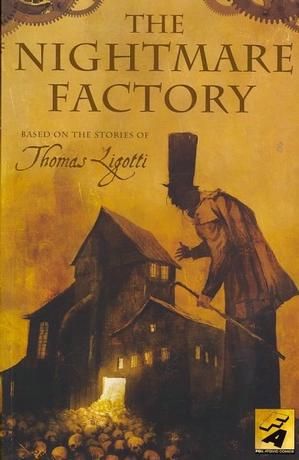
The Nightmare Factory


This is a comic adaptation of some stories by Thomas Ligotti, who is apparently famous. In my original review of this book, I said it was confusingly terrible, but after doing further research I have to say that I just don’t understand Ligotti’s vision and he would probably want someone like me to have the reaction I did. From this sample of four, I can say that Ligotti’s idea of a horror story goes something like this:

An underdeveloped male character, probably kind of depressed and studious, hears about something bad. A big group of people do something mysterious. Something scary and disturbing is seen. The protagonist is a little creeped out but ultimately just miserable. At the end of the story he’s even more depressed and makes a comment about how his sanity is lost forever.

I am a dull person and I guess I enjoy by-the-numbers horror. To me the scariest part of a horror story is usually the explanation or realization of the horror. Whenever a disturbing image would appear in Ligotti’s stories, I would get excited for the reveal of where the image came from or what it signified, but instead the main character would just reveal how depressed and miserable he was.

When I internet researched Thomas Ligotti he seemed like a respectably consistent guy who, rather than failing to write what I expected from a horror story, is just pursuing entirely different goals. He says that he’s very depressed, hates everything, isn’t interested enough in real life to write realistic characters, and only wants to communicate how much he hates everything and thinks life is meaningless. He actually seems like a nice guy.

I wouldn’t read any more of his writing, but I did think the second and third story in the graphic novel had interesting art, and the art in the fourth story was beautiful.