I was excited about this blog but I haven't really been keeping it up. As always I've been watching TV though, so here's some stuff I've watched in the last year:
Grimm season two was better than season one. They sidelined Juliette, the worst character. They let Hank, Nick's partner, find out about the animal people so he just wasn't awkwardly wondering what was going on all the time. Towards the end of season one they introduced Rosalee, a fox person who is a love interest for Monroe, the only charismatic character in the first season. Monroe is a wolfman who has decided not to hunt and kill humans, instead going in the other direction of repairing clocks, setting up elaborate Christmas and Halloween decorations, and drinking craft beer. Silas Weir Mitchell, who plays Monroe, is really cute but has something slightly awkward and creepy about him.
I guess I should have mentioned him when I reviewed the show before but I don't think I did. The short version is that the concept and execution of Monroe is the only thing on the show that ever got my attention and it doesn't take a lot to get my attention. Rosalee isn't quite as good as Monroe, but she's appealing and very pretty, and their relationship increases the amount of the show that isn't about really boring characters doing really boring things. Also did I mention the show now sort of has arcs and isn't just about Nick finding out that all murderers are actually snakes?
I'm not saying Grimm has become good, but there have been times that I was sorry the episode was over and I genuinely was frustrated during the midseason hiatus. It also has all the wonderful moments Grimm has always had, like when a woman is on a date with a guy and says, "I'm sorry I'm always crying," and the guy says, "But I want you to cry," grows a giant tongue, licks her tears, blinds her, says, "It's better if you can't see this," and then turns into a giant fly and kills her.
Lost Girl. I watched seasons one and two last year and loved them. The first episode of season three was like the Michigan Womyn's Music Festival in the form of a genre TV show, although I will give the writers some credit for sort of apologizing when people were mad about it, but they didn't really apologize that much. "I'm sorry you thought this 'demon,' who looks like a woman but has a penis and stubble and is trying to get into female-only spaces in order to rape women, was supposed to be a trans woman. Obviously it's just an imaginary demon." (It was also really sad to see queer cis women on AfterEllen.com implying that no one should criticize Lost Girl because it portrays queer cis women positively.)
Anyway that put me off the show for a while. When I started watching again, all the other episodes in the season were pretty good. The best part was Tamsin, a new love interest for Bo who is actually likable. I know I'm the only person in the world who hates Lauren, Bo's first female love interest, but I just think she is the worst and it was so great to get a character like Tamsin.
Also just really appreciate how much of the show is given over to female characters, female friendships, and lesbian relationships.
Community. Haven't watched season four, don't care, never will. I can't believe I've never written about this show on here because I've been seriously in love with it for...like a year now? It really meets all my ideals of what an ensemble show should be by trying to compassionately portray people who are really different from each other. I think Shirley (the character who is most different from the most central character, Jeff, and also probably from most of the viewers) is written kind of weakly though and could be better.
Obviously the pop culture references are one of the most notable things about the show and I love them, but I got into it because I heard good things about Abed, the Autistic character. I have a whole lot to say about Abed so I will say it some other time. Basically I like how the show inverts so many tropes about how to portray Autistic, crazy, or disabled characters though. Abed is often portrayed as smarter, more in the know, etc. than the other characters--he's not othered so much by them and when he is, they're usually shown to be wrong--and the show makes constant sneaky references to his disability, without talking about it so bluntly that it seems like they're trying to be educational or define him by his disability. I don't know. It's really classy.
Game of Thrones. Watched the first season, read the first book, spoiled myself for EVERYTHING and got really into reading theories and analyses by fans, started reading the second book, watched the second season, and got so overwhelmed by the length of the book and so offended by the crappiness of the adaptation that I just gave up on everything. Then in the last few months, I started reading the books again and this time am really enjoying the length and density and kind of appreciating the show as a chance to relive the books, even though the show fundamentally misses the point of the books.
I won't go on about this because lots of people have written about it much better than me, but just an example. In both the show and the books, a guy gets married to a woman who, for political reasons, he shouldn't marry. To avoid spoilers let's call the guy Donald. In the book, Donald is a 15- or 16-year-old who had sex with a girl because he was stressed out, and now he wants to marry her because he ruined her life by taking her virginity. He announces this out of nowhere and is freaking out about what an idiot he is. In the narrative, this event isn't even treated as that important because Donald isn't a POV character, even though forbidden love is usually this dramatic, world-altering thing, especially in fantasy fiction.
In the show, Donald is the hero and is an adult, and his girlfriend is elevated to a much more major character who shocks him by standing up to him even though he's really powerful (something that would be really unsafe to do in that society!) and travels around the world doing awesome heroic things (something that would be really unsafe to do in that society!) and even kind of snarks about other women who aren't cool enough to travel around the world being heroic and sticking it to powerful men. The book series has smart, talented women characters accomplishing what they can in a patriarchal structure, and this character is a complete fuck you to that by implicitly blaming them for their own oppression. There's also sort of an implication that Donald and his girlfriend are just getting married because Donald decides it's lame to take political consequences into account. The show version of the romance undoes the cleverness of the book version, where instead of being super-romantic and the main thread of the story, the forbidden love happens off to the side and everyone feels like an idiot.
So, yeah. And then this kind of thing is about 50% of the show. The ASOIAF books subvert expectations for fantasy fiction and then the people adapting it for TV are just like, "But fantasy fiction isn't supposed to be like this! Let's make it more like he should have written it, i.e. more stereotyped!"
I probably watched some more shows but now I'm bored. Oh I watched Parks and Recreation. It's fine/would watch again.
Thursday, May 23, 2013

Sunday, January 27, 2013
American Horror Story
This show has a format I had never heard of before--an anthology where each story is a season long. Several of the season one actors returned for season two, playing totally different characters, which was something I liked. More than the anthology format or the actors playing different roles, American Horror Story is defined by the fact that it tries to combine too many things into one narrative, making a huge mess that can’t help but delight you.
The first season was written worse and it was obvious the writers were coming up with twists and revelations on the fly; on the other hand, there was only one source of mayhem. The Harmon family had moved into a house where a ridiculous number of people had died, and over time, a bunch of ghosts appeared and did different things. There were all kinds--gay ghosts, disabled ghosts, nurse ghosts, a baby ghost, and even a handsome ghost who shot up his high school and (in the most disturbing twist of all) amassed a tumblr fanbase of teenage girls who were angry that the ghost’s love interest wouldn’t forgive him for killing people. I’ve barely spoiled anything, as I only listed about 10% of the total ghosts in the house. Wherever you looked, there was a new ghost, and it was hard to make it five minutes without laughing.
The second season was less immediately appealing to me because it takes place in an “insane asylum.” I’ve written before about my frustration with this setting--it draws on the fear of crazy people to make itself more interesting, but invariably, the heroes and villains are not crazy and we only see crazy people tottering around in the background wearing straitjackets. (This season has pretty much done what I expected--although, as with last season, Ryan Murphy makes an admirable effort to portray and condemn discrimination against people with developmental disabilities.) Also, I just don’t personally find asylums as appealing as a haunted house.
I kept watching, though, and found that the second season was actually somewhat well written and not entirely ridiculous. This time around, the story seems like it’s actually been planned out a little, and all the point of view characters are interesting and likable (with an apparently villainous character coming around to be one of the heroes). On the other hand, there are way too many kinds of monsters. We get the spooky asylum with some “criminally insane” patients, demon possession, murderous mutants, a serial killer, and aliens, all introduced in the first few episodes. It’s too bad because the story would be perfectly fine with a few of these elements removed, and it seems like there aren’t even going to be any remaining tropes for Ryan Murphy to use in the third season. Is he afraid the show’s going to get canceled and he has to use everything now?
If he is afraid of that, I don’t know why he would be. As far as I can tell the show is pretty popular, and understandably so because it’s one of the most relentlessly entertaining things I’ve ever seen.
The first season was written worse and it was obvious the writers were coming up with twists and revelations on the fly; on the other hand, there was only one source of mayhem. The Harmon family had moved into a house where a ridiculous number of people had died, and over time, a bunch of ghosts appeared and did different things. There were all kinds--gay ghosts, disabled ghosts, nurse ghosts, a baby ghost, and even a handsome ghost who shot up his high school and (in the most disturbing twist of all) amassed a tumblr fanbase of teenage girls who were angry that the ghost’s love interest wouldn’t forgive him for killing people. I’ve barely spoiled anything, as I only listed about 10% of the total ghosts in the house. Wherever you looked, there was a new ghost, and it was hard to make it five minutes without laughing.
The second season was less immediately appealing to me because it takes place in an “insane asylum.” I’ve written before about my frustration with this setting--it draws on the fear of crazy people to make itself more interesting, but invariably, the heroes and villains are not crazy and we only see crazy people tottering around in the background wearing straitjackets. (This season has pretty much done what I expected--although, as with last season, Ryan Murphy makes an admirable effort to portray and condemn discrimination against people with developmental disabilities.) Also, I just don’t personally find asylums as appealing as a haunted house.
I kept watching, though, and found that the second season was actually somewhat well written and not entirely ridiculous. This time around, the story seems like it’s actually been planned out a little, and all the point of view characters are interesting and likable (with an apparently villainous character coming around to be one of the heroes). On the other hand, there are way too many kinds of monsters. We get the spooky asylum with some “criminally insane” patients, demon possession, murderous mutants, a serial killer, and aliens, all introduced in the first few episodes. It’s too bad because the story would be perfectly fine with a few of these elements removed, and it seems like there aren’t even going to be any remaining tropes for Ryan Murphy to use in the third season. Is he afraid the show’s going to get canceled and he has to use everything now?
If he is afraid of that, I don’t know why he would be. As far as I can tell the show is pretty popular, and understandably so because it’s one of the most relentlessly entertaining things I’ve ever seen.
Wait Till Helen Comes--Mary Downing Hahn

When I was growing up there were certain books I would read constantly, and this was one of them. I found it when I was visiting my parents and decided to reread it, since I probably hadn’t done so for at least ten years.
It might be because I remembered the plot twists, but the first 80% of the book is super slow and boring. The protagonist is Molly, a supposed preteen who acts like an oversensitive 5-year-old. Sample narration: “I was anxious to run away from the bones in the graveyard, but I couldn’t run away from the bones in my own skin!” Molly likes nothing more than to write poems about rainbows and sunlight, collect unicorns, and listen to Emily Dickinson poems on tape to distract herself from her fear of death (I’m wondering if Mary Downing Hahn has read any of Emily Dickinson’s poems).
Molly’s brother Michael is the only semi likable character in the book. He likes science and nature and his main role is to make fun of Molly for believing in ghosts--although amusingly, he thinks ESP and poltergeists are real. At one point he tells Molly she’s stupid not for saying a poltergeist trashed their house, but for saying it looked like a person. Real poltergeists are invisible.
Their spacey mom, Jean, is a painter who recently married Dave, a potter. The whole family moves to the middle of nowhere for the summer so the selfish parents can work on their art. They tell Molly and Michael that it’s their responsibility to take care of Dave’s traumatized 7-year-old daughter, Heather.
Unfortunately, Heather is an awful girl who hates Jean and likes to set up Michael and Molly so they look like they’re bullying her. Soon she becomes friends with a little ghost named Helen who is trying to convince her to kill herself so they can “live together with unicorns eating roses in a crystal palace.” Even though unicorns eating roses sounds disgusting, Heather is enthralled and totally wants to do it.
The majority of the book is the same incident over and over: Molly sees Heather talking to Helen/wearing the necklace Helen died in/generally being creepy, Molly tries to go to an authority figure, Heather denies the story and accuses Molly of bullying her, and all the other family members either get mad at Molly, or mercilessly tease her for being afraid of death and ghosts. In several scenes, the entire family laughs at Molly for being a wuss. Even though Molly is hysterically crying 90% of the time, Dave believes that she is a sadistic kid who’s making up ghost stories to scare his daughter. He also refuses to consider that Heather might have problems even though she saw her mother die and is constantly clinging to him, crying, screaming, and having night terrors.
This was extremely frustrating, and I guess I must have found it rewarding to read about when I was a kid because it tapped into a universal sensitive-poetry-girl feeling of being teased and having no one understand you. This time around, though, I was just bored. I also thought that Dave and Jean were horrible people! Maybe this is something Downing Hahn deserves to be commended for because she doesn’t put the parents on a pedestal, but by the end of the book I couldn’t even accept them as decent. They just seemed mean and lazy.
Of course, Molly does herself no favors by talking about ghosts instead of just telling people that Heather is spending all her time in gross, dangerous places where multiple people have died. I didn’t remember how dumb she was.
After slogging through the majority of the book, I finally got to the end where Helen actually does some scary stuff and it’s up to Molly to save Heather, showing her love for her so they can finally become real sisters. This part is fine, and although it isn’t scary to me now, it’s probably a good level of scary for an 8- or 10-year-old. Maybe the length was intended to develop Heather’s character, but I can’t help feeling that the book would be so much better if there were half as many incidents of Michael, Heather, Dave, and Jean ganging up on Molly.
Saturday, January 26, 2013
The Nightmare Factory
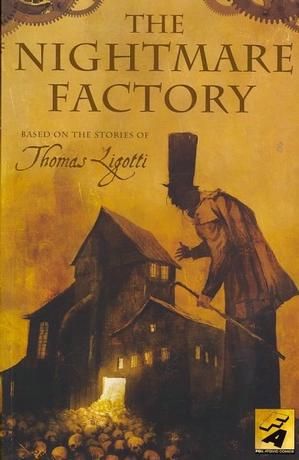
This is a comic adaptation of some stories by Thomas Ligotti, who is apparently famous. In my original review of this book, I said it was confusingly terrible, but after doing further research I have to say that I just don’t understand Ligotti’s vision and he would probably want someone like me to have the reaction I did. From this sample of four, I can say that Ligotti’s idea of a horror story goes something like this:
An underdeveloped male character, probably kind of depressed and studious, hears about something bad. A big group of people do something mysterious. Something scary and disturbing is seen. The protagonist is a little creeped out but ultimately just miserable. At the end of the story he’s even more depressed and makes a comment about how his sanity is lost forever.
I am a dull person and I guess I enjoy by-the-numbers horror. To me the scariest part of a horror story is usually the explanation or realization of the horror. Whenever a disturbing image would appear in Ligotti’s stories, I would get excited for the reveal of where the image came from or what it signified, but instead the main character would just reveal how depressed and miserable he was.
When I internet researched Thomas Ligotti he seemed like a respectably consistent guy who, rather than failing to write what I expected from a horror story, is just pursuing entirely different goals. He says that he’s very depressed, hates everything, isn’t interested enough in real life to write realistic characters, and only wants to communicate how much he hates everything and thinks life is meaningless. He actually seems like a nice guy.
I wouldn’t read any more of his writing, but I did think the second and third story in the graphic novel had interesting art, and the art in the fourth story was beautiful.
Friday, April 13, 2012
Grimm
I love Grimm because I can't believe it's real. It resembles a fantasy story written by a 12-year-old who isn't suited to be a fantasy writer, but doesn't know it yet. I've been there. When I was 12 I loved werewolves, but I was too lazy to learn about wolf physiology or come up with any rules for how transformations would work. So all my stories were about "werewolves" who didn't actually turn into wolves. Now I discover that adults can get paid to write a TV show about werewolves who don't turn into wolves.
The "plot" of Grimm is that a police detective founds out he's one of a long line of monster hunters, which included the Brothers Grimm. One tagline of the show is "The Tales Are Real," implying that the monsters are going to be villains from fairy tales. For about two episodes the show actually tried to stick to this, but pretty soon it surrendered and the crimes Nick solves can now correspond to fairy tales, random contemporary literature, or nothing at all. The correspondence is usually really forced, like a feral child who uses her hair as a weapon is supposed to be Rapunzel, and this originally drove me crazy but I decided to just try and forget that the episodes were supposed to be based on stories.
Now I'm free to enjoy the incredibly low-concept monsters. Here is the low concept: some people are part animal. As far as I can tell most of them don't actually transform into the animal, they're just sort of like it. Occasionally this gives them abilities or conditions that are actually supernatural, like when a spider woman has to kill and eat men to avoid aging rapidly, just like the episode of Fringe where the same thing happened. But most of the time we learn that snake people are good lawyers, mouse people are shy, and rat people have a special connection to rats. The only thing that makes the average Grimm episode a fantasy is that at some point Nick's magic powers allow him to see a vision of a person's face turning into a CGI animal. Then he goes home and reads a book that tells him what personality traits that animal/person has.
Now that I think about this it seems really messed up. "I just found out that the suspect is black! I'm going to go to the library and look up what kind of crimes black people commit!" But you know, wolf people and so on are not real, so it's all in good fun and I've managed to remain unaware of this implication until now.
I think what I find appealing about Grimm is that it seems so real. The magic is exactly as boring as magic would be in real life. The monsters seem something other than human when they actually have powers, but they usually don't, and the Amazing Revelation of magic is basically: "Hey, you know that guy who killed someone for a reason that already makes sense? Well, his worldview was influenced by the fact that he was part lion."
Maybe it's more like Aesop's Fables than fairy tales, but the monsters are never able to be metaphors for humans because they explicitly identify as non-human and have their own culture. Grimm ends up being the most childlike show possible as it comes close to implying no human evil is really the fault of humans. Most murderers, rapists, etc. are just animal/people pretending to be people.
And you can't Godwin your way out of this, because in a recent episode, Nick was inexplicably watching footage of Hitler when Hitler's face turned into a CGI wolf! It all becomes clear: Hitler didn't hate Jews, he just wanted to eat them. I don't think this radically silly message was intended, even though when you think about it it's the only way to read the show. Its complete unawareness of how offensive and ridiculous it is makes Grimm the most adorable show on television.
Three-second review: I've been watching Lost Girl, which could be VERY lazily described as a combination of Angel and Buffy, and maybe Neil Gaiman. Not life-changing but it has been completely satisfying from the beginning. The worldbuilding is pretty good, ~strong female characters, gay and straight love interests treated equally, silly jokes, basically a good time.
The "plot" of Grimm is that a police detective founds out he's one of a long line of monster hunters, which included the Brothers Grimm. One tagline of the show is "The Tales Are Real," implying that the monsters are going to be villains from fairy tales. For about two episodes the show actually tried to stick to this, but pretty soon it surrendered and the crimes Nick solves can now correspond to fairy tales, random contemporary literature, or nothing at all. The correspondence is usually really forced, like a feral child who uses her hair as a weapon is supposed to be Rapunzel, and this originally drove me crazy but I decided to just try and forget that the episodes were supposed to be based on stories.
Now I'm free to enjoy the incredibly low-concept monsters. Here is the low concept: some people are part animal. As far as I can tell most of them don't actually transform into the animal, they're just sort of like it. Occasionally this gives them abilities or conditions that are actually supernatural, like when a spider woman has to kill and eat men to avoid aging rapidly, just like the episode of Fringe where the same thing happened. But most of the time we learn that snake people are good lawyers, mouse people are shy, and rat people have a special connection to rats. The only thing that makes the average Grimm episode a fantasy is that at some point Nick's magic powers allow him to see a vision of a person's face turning into a CGI animal. Then he goes home and reads a book that tells him what personality traits that animal/person has.
Now that I think about this it seems really messed up. "I just found out that the suspect is black! I'm going to go to the library and look up what kind of crimes black people commit!" But you know, wolf people and so on are not real, so it's all in good fun and I've managed to remain unaware of this implication until now.
I think what I find appealing about Grimm is that it seems so real. The magic is exactly as boring as magic would be in real life. The monsters seem something other than human when they actually have powers, but they usually don't, and the Amazing Revelation of magic is basically: "Hey, you know that guy who killed someone for a reason that already makes sense? Well, his worldview was influenced by the fact that he was part lion."
Maybe it's more like Aesop's Fables than fairy tales, but the monsters are never able to be metaphors for humans because they explicitly identify as non-human and have their own culture. Grimm ends up being the most childlike show possible as it comes close to implying no human evil is really the fault of humans. Most murderers, rapists, etc. are just animal/people pretending to be people.
And you can't Godwin your way out of this, because in a recent episode, Nick was inexplicably watching footage of Hitler when Hitler's face turned into a CGI wolf! It all becomes clear: Hitler didn't hate Jews, he just wanted to eat them. I don't think this radically silly message was intended, even though when you think about it it's the only way to read the show. Its complete unawareness of how offensive and ridiculous it is makes Grimm the most adorable show on television.
Three-second review: I've been watching Lost Girl, which could be VERY lazily described as a combination of Angel and Buffy, and maybe Neil Gaiman. Not life-changing but it has been completely satisfying from the beginning. The worldbuilding is pretty good, ~strong female characters, gay and straight love interests treated equally, silly jokes, basically a good time.
Monday, March 19, 2012
short form TV diary
Blogging about TV makes me feel better about how much I watch, but I've neglected to write about 95% of what I've been watching.
shows I've started this fall/winter/spring:
The Vampire Diaries. Aside from being "so bad it's good" or whatever, I think this show is interesting because it avoids the hypocrisy of most vampire-romance fiction. The main characters just are really selfish and awful, and that's okay. The show doesn't try to hide or excuse that Stefan and Damon are former (sometimes current) serial killers. Elena isn't in denial, she just doesn't care.
China, IL. After the last episode we watched, Clayton said, "I wish they would just let Brad Neely make one Professor Brothers and one Baby Cakes video and show them as an episode." It's not unpleasant to watch, but it seems like they had to make all these changes to do a BRAD NEELY ADULT SWIM SHOW because the original videos didn't conform to some stereotype of what Adult Swim shows are supposed to be like. They had to "improve" the animation for no reason and make Baby Cakes unrecognizable/terrifying looking, and every episode has a huge fantastical epic story arc, when one of the best things about the original videos was how mundane they were.
My Little Pony Friendship is Magic. Highly amazing show.
The Fades.
Bedlam. Hilariously, almost the whole cast is going to be replaced for series 2.
Game of Thrones. I'm enjoying this a lot.
American Horror Story. This was great.
Grimm. This seems like it would just be one of those placeholder shows where you're like "why is this on TV, does anyone actually care about it at all?" and indeed there are some obviously terrible things about it. For example, did you know Hitler was a wolfman? But something about its particular flaws makes me imagine it's being written by a 10-year-old who sincerely cares about the show, and I find it relentlessly enjoyable.
shows I've been watching for years but finally sat down and watched every episode of and/or caught up with:
United States of Tara. I feel like most TV critics just don't like crazy people very much because it seems like the more grimdark the show gets, the better they think it is. Whereas when it was more of a comedy, they were like "this show is offensive and unrealistic because it doesn't portray how hard it is to live with a crazy person." I enjoyed watching it to the end, but I definitely didn't feel that it became a better show. In fact, I kind of think it got less interesting.
Six Feet Under. I know this is a good show, but I'm so glad I finished watching it because it seems like all the writers have the same problems as me. I like depressing TV, I really do, but I just could not handle that every episode addressed something I was depressed about in real life.
Flight of the Conchords. Best show ever made (seriously, it's perfect--never stops being funny for a minute, and somehow doesn't annoy me with how sweet and innocent it is, even though I usually find that annoying, as with Portlandia).
Mr. Show. Other best show ever made.
Portlandia. This never fails to disappoint me but I'll keep watching because of my high school crush on CB.
attempted rewatches that I didn't really get that far with and don't have much to say about because I obviously like the show or I wouldn't have been rewatching it:
Spaced, Buffy the Vampire Slayer, Battlestar Galactica, Mad Men, Being Human, Skins.
abandoned shows:
Skins. I was actually going to keep watching after the first episode, but Josh told me that the best-looking girl on the show, who also happens to be part of my OTP, died. Obviously shipping and attractive girls are huge motivations for sticking with a show that isn't good, and I no longer felt motivated. I also felt annoyed because since the end of last season, everyone in fandom has predicted that this character would die. It seems like she died because there has to be a mandatory death in every generation (in every generation a mandatory death is born!) and the writers didn't want to deal with either developing the OTP, or breaking them up to get back together at the last minute like Sid/Cassie and Naomily. I guess I can see why this would be difficult, but they just destroyed the only reason I would be interested in the show. Why did they retcon Minky?? That would have kept every lesbian in the world obsessed with Skins during series 6.
The Walking Dead. Maybe I'm just really tired of zombies, they're so horrifying yet so uninteresting. I was never motivated to start season 2.
Being Human. When I heard that not one but three of the four main actors would be leaving the show (with one actor quitting so suddenly that they had to say the character died offscreen), it just didn't sound like Being Human to me and I wasn't interested. Josh has been really positive about the new incarnation though so I'll probably get around to checking it out.
to watch list:
Lost Girl. The Onion AV Club did a weird review of this show where they talked about how the production is really bland in a distracting way (and all the actors are "bored Canadian models") but somehow the show itself is good? They compared it to Buffy and Angel. I also heard that the main character dates a man and a woman and this is a non-issue. So I'm very interested and likely to start this today or tomorrow.
The Secret Circle. This is by the creators of Vampire Diaries and I watched the first episode with Clayton several months ago. Everyone is pretty good-looking and lives in a good-looking town.
The Increasingly Poor Decisions of Todd Margaret. Clayton and I were trying to watch this in fall 2010 but I got so mad when Russell Tovey was replaced after the pilot that I flipped my lid and refused to watch anymore. I am finally starting to get over it and Clayton's interested in trying again.
how great my life is going to be in a week when Mad Men starts and then a week after that Game of Thrones starts:
pretty great.
shows I've started this fall/winter/spring:
The Vampire Diaries. Aside from being "so bad it's good" or whatever, I think this show is interesting because it avoids the hypocrisy of most vampire-romance fiction. The main characters just are really selfish and awful, and that's okay. The show doesn't try to hide or excuse that Stefan and Damon are former (sometimes current) serial killers. Elena isn't in denial, she just doesn't care.
China, IL. After the last episode we watched, Clayton said, "I wish they would just let Brad Neely make one Professor Brothers and one Baby Cakes video and show them as an episode." It's not unpleasant to watch, but it seems like they had to make all these changes to do a BRAD NEELY ADULT SWIM SHOW because the original videos didn't conform to some stereotype of what Adult Swim shows are supposed to be like. They had to "improve" the animation for no reason and make Baby Cakes unrecognizable/terrifying looking, and every episode has a huge fantastical epic story arc, when one of the best things about the original videos was how mundane they were.
My Little Pony Friendship is Magic. Highly amazing show.
The Fades.
Bedlam. Hilariously, almost the whole cast is going to be replaced for series 2.
Game of Thrones. I'm enjoying this a lot.
American Horror Story. This was great.
Grimm. This seems like it would just be one of those placeholder shows where you're like "why is this on TV, does anyone actually care about it at all?" and indeed there are some obviously terrible things about it. For example, did you know Hitler was a wolfman? But something about its particular flaws makes me imagine it's being written by a 10-year-old who sincerely cares about the show, and I find it relentlessly enjoyable.
shows I've been watching for years but finally sat down and watched every episode of and/or caught up with:
United States of Tara. I feel like most TV critics just don't like crazy people very much because it seems like the more grimdark the show gets, the better they think it is. Whereas when it was more of a comedy, they were like "this show is offensive and unrealistic because it doesn't portray how hard it is to live with a crazy person." I enjoyed watching it to the end, but I definitely didn't feel that it became a better show. In fact, I kind of think it got less interesting.
Six Feet Under. I know this is a good show, but I'm so glad I finished watching it because it seems like all the writers have the same problems as me. I like depressing TV, I really do, but I just could not handle that every episode addressed something I was depressed about in real life.
Flight of the Conchords. Best show ever made (seriously, it's perfect--never stops being funny for a minute, and somehow doesn't annoy me with how sweet and innocent it is, even though I usually find that annoying, as with Portlandia).
Mr. Show. Other best show ever made.
Portlandia. This never fails to disappoint me but I'll keep watching because of my high school crush on CB.
attempted rewatches that I didn't really get that far with and don't have much to say about because I obviously like the show or I wouldn't have been rewatching it:
Spaced, Buffy the Vampire Slayer, Battlestar Galactica, Mad Men, Being Human, Skins.
abandoned shows:
Skins. I was actually going to keep watching after the first episode, but Josh told me that the best-looking girl on the show, who also happens to be part of my OTP, died. Obviously shipping and attractive girls are huge motivations for sticking with a show that isn't good, and I no longer felt motivated. I also felt annoyed because since the end of last season, everyone in fandom has predicted that this character would die. It seems like she died because there has to be a mandatory death in every generation (in every generation a mandatory death is born!) and the writers didn't want to deal with either developing the OTP, or breaking them up to get back together at the last minute like Sid/Cassie and Naomily. I guess I can see why this would be difficult, but they just destroyed the only reason I would be interested in the show. Why did they retcon Minky?? That would have kept every lesbian in the world obsessed with Skins during series 6.
The Walking Dead. Maybe I'm just really tired of zombies, they're so horrifying yet so uninteresting. I was never motivated to start season 2.
Being Human. When I heard that not one but three of the four main actors would be leaving the show (with one actor quitting so suddenly that they had to say the character died offscreen), it just didn't sound like Being Human to me and I wasn't interested. Josh has been really positive about the new incarnation though so I'll probably get around to checking it out.
to watch list:
Lost Girl. The Onion AV Club did a weird review of this show where they talked about how the production is really bland in a distracting way (and all the actors are "bored Canadian models") but somehow the show itself is good? They compared it to Buffy and Angel. I also heard that the main character dates a man and a woman and this is a non-issue. So I'm very interested and likely to start this today or tomorrow.
The Secret Circle. This is by the creators of Vampire Diaries and I watched the first episode with Clayton several months ago. Everyone is pretty good-looking and lives in a good-looking town.
The Increasingly Poor Decisions of Todd Margaret. Clayton and I were trying to watch this in fall 2010 but I got so mad when Russell Tovey was replaced after the pilot that I flipped my lid and refused to watch anymore. I am finally starting to get over it and Clayton's interested in trying again.
how great my life is going to be in a week when Mad Men starts and then a week after that Game of Thrones starts:
pretty great.
Tuesday, January 17, 2012
why I love/d Skins
I love Skins. I think there's an argument to be made for it being the the best TV show EVER (by my standards of TV, at least). I've wanted to write a post about exactly why I love it and I know I have to get the post out before I watch the first episode of the new series, because from everything I've heard, the show has totally and completely jumped the shark and I'm not going to be able to feel the same way about it.
It's had low points before but the basic greatness of the concept has more than made up for them. But the new series just sounds like it's going to be awful. It sounds like they changed basic facts about characters, including stuff that I thought was important, to try and turn the show into a no-holds-barred festival of teen sex, drinking, and drug use--which people have always stereotyped it as, but which it really isn't.
Skins is a British show about a diverse group of teenage friends, most of whom party a lot. This sounds like a lot of shows, but the two unique things about Skins are:
1. It follows the characters while they are in college (which in the UK means a two-year program that some people go to between secondary school and university). Every two seasons, the main characters are replaced with a new group.
2. Every episode is told from the perspective of a different character--theoretically, each main character is supposed to get their own episode every season, although this doesn't always happen. The tone of the show changes to better reflect the inner life of the main character of the episode, and the music for the episode is often a particular genre or musician that is suited for the character.
So even though some people may like a particular Skins "generation" better than another, the show ultimately isn't about a specific group of teenagers, but about exploring each group of teenagers thoroughly and trying to portray their experiences with emotional truth. This leads to unexpected shifts in genre, which I love--a supporting character is revealed to have been imaginary; an episode about a road trip starts to resemble a horror movie; a long section of an episode is silent because the main character temporarily loses his hearing.
Skins isn't very realistic, but it deals with what teenagers are feeling, which is not a realistic subject. The credits of the show are weirdly colored, sped up and spliced together footage of the characters kissing, drinking, and walking around--often in giant, grassy fields, despite the fact that most of the show takes place in urban areas. A lot of the trailers for the show have been fantastical, like the one where the main characters are imagined as the different victims and inhabitants of a haunted house.
Besides the genre shifting, the structure of Skins does something important politically. When I say a TV show is political, all I mean is that it portrays people who are outside of the mainstream as having their own points of view and feelings. A lot of TV writers start out with a cast containing some gay people and people of color (and people with other non-mainstream experiences like disabilities), only focus on white straight characters most of the time. It might be different now, but the early episodes of Glee struck me this way. I feel like we've gotten to the point where writers feel compelled to make their show look diverse, but they don't really care about developing those characters or themes.
The Skins writers lean as firmly this way as anyone. Each generation ended up focusing on the tormented relationship between a white boy and a white girl (who was sometimes mentally ill, but in a sexy way). This really brought down gen 2 particularly, and from what I hear, it's going to be the death of gen 3.
But because of the structure of the show, this doesn't happen as severely as in other shows. We have gotten some really cool plots. Like: two episodes about a guy with autism trying to assert his "normalcy" and his right to grow up and have sex. An episode (and an admittedly terrible half-episode) about a guy immigrating to England from the Congo and having trouble adjusting. Several great episodes about characters with mental illnesses. A hugely popular storyline about two girls falling in love. A Muslim boy who's accused of using his religion as an excuse to be homophobic, and has to face how complicated his commitment to Islam is.
This is so, so special to me.
I feel really lucky that I started watching the show out of order--the first clip I saw was from the end of season 4 which, at the time, was widely considered to be the worst season of the show. I then watched 3x07, the best disability-related hour of TV I've ever seen. Then I watched series 3, series 4, series 1, and series 2, which meant that even though I liked individual episodes better than others, I didn't really have a chance to do the "negatively comparing gen 2 to gen 1" thing that a lot of Skins fans do. It's all Skins to me, and when gen 3 started last year, that was Skins too. I have a really bad feeling that series 6 is not going to feel like Skins at all.
Quick generation reviews/descriptions for interested parties (you should probs watch Skins, everyone!):
GENERATION ONE revolves around Tony, a charming and adventurous boy who treats all his friends terribly but manipulates them enough that they don't know how to stand up to him. His two biggest victims are his girlfriend Michelle and his sidekick Sid, who are both incredibly insecure in different ways. Eventually he gets his comeuppance, sort of.
Also: Michelle's friend Cassie, who has mental health problems, becomes infatuated with Sid, but Sid is obsessed with Michelle. Oh no! Chris is irresponsible and Jal is a serious musician, so they obviously fall in love. Tony's younger sister Effy goes long periods of time without talking, is creepy, and is the only person Tony cares about. There's also Maxxie, Anwar, Sketch, and Daniel Kaluuya, but the writers forgot about them.
In GENERATION TWO Effy is the main character and while I don't really have a problem with her as a person, everything starts being about how attractive she is. Two best friends, Freddie who is boring, and Cook who is an over the top delinquent, fall in love with Effy and compete for her attention. Over the course of a few episodes, Emily and Naomi fall in love and become so popular that the writers try to focus on them in season four, only to forget to develop them for almost the whole season and have to rush to wrap up their storyline in the last episode, which is more than they did for any of the other storylines.
Gen 2 was kind of different from gen 1 in that the main characters didn't start out as a group of friends, but as duos and trios. The most unbelievable thing about the show at this point was that all the characters would hang out together even though there were really tenuous reasons for this to happen. JJ is Freddie and Cook's friend with autism and Pandora is Effy's awkward friend, but instead of being friends with each other both characters would just disappear from the show for long periods of time, probably because they weren't sexy enough. Katie is Emily's sister who sort of hangs out with Effy and Freddie for some reason, Thomas is Pandora's boyfriend and in parts of season four is suddenly friends with JJ, but he usually disappears too.
As I write this I can see that there are more obvious problems with gen 2 than gen 1, but I still love them equally. I guess they basically have the same amount of characters, but gen 2 feels like it has more characters because they aren't all friends with each other so the characters we see can shift drastically from episode to episode. Also, Panda, JJ, and Thomas don't get shortchanged/buried to the degree that Maxxie and Anwar did, even though it still happens.
GENERATION THREE goes to an even further extreme and starts with a character named Franky, who has no friends, meeting the various characters for the first time. For some reason it didn't annoy me that all the characters ended up hanging out, because they were just AWESOME and best of all, they all seemed kind of dorky and singularly unlikely to take over the whole show with their broody sexy coolness, like Effy horrifically did in gen 2.
But tragedy struck! Franky falls in love with a broody, sexy, cool guy named Matty. Matty doesn't get that much screen time but through her relationship with him, Franky loses every quality that made her an exciting character in the first place (when she first appeared she was traumatized by severe bullying, liked to wear men's clothes, and made stop motion movies--guess how many of these qualities remained at the end of the season). The writers obviously saw Franky/Matty as a great romance, but because of the way they had set up the generation, discerning viewers could ignore the horribleness and pay attention to the other characters, who were, as I mentioned, awesome. Rich cares a lot about being "metal," but wears a hairnet and freaks out because he ran out of moisturizer. Grace is fantastic, Alo lives on a farm, Nick smashes things with a baseball bat because his dad is a motivational speaker, Liv does all the broody sexy cool things without actually becoming that character, and Mini is just...the finest.
For a second it seemed like Mini was going to be the annoying character we were all supposed to look up to and think was cool, but by about ten minutes into the first episode it became clear she was a huge loser. She wanted to be really fashionable, but because she hated her body she would wear these weird leggings under all her dresses. She wanted to be seen as sexually active, but she didn't want to have sex and kept trying to avoid it. When she finally had sex it was awful, but she kept doing it because she wanted people to think she liked it. Eventually, Mini had the opposite trajectory from Franky--she went from an asshole to a funny, complicated, heartbreaking character that everyone loved.
I realize that, consistent with popular fandom opinion, the first generation must be the most objectively good one--because after all, each of my descriptions is longer and more full of backpedaling as I try to explain why this generation is still good despite its flaws. Okay. Fair enough. But they really are all really good and I would rather watch the worst episode of Skins than watch anything else.
Until now. Because judging by spoilers for series 6, they have changed stuff about the characters to the extent that it seems like they don't even understand what is good about their own show. Both of the showrunners have left but they're still writing episodes, so they must have a hand in this and they should know better. It's super offensive to take a character who, while having sex, had a PTSD flashback and tried to kill herself, and start the season with her happily having sex all the time. It's shitty to portray a girl as having a crush on another girl, and then start the next season with both girls involved with men, and basically make fun of lesbian fans for wanting another f/f relationship on the show. It's just dumb to have Rich dress in a really distinctive way in season five, and then make him look like all the other characters in season six. It doesn't offend me, it's just BORING. Why is it so wrong to portray diverse and unique experiences instead of getting sucked into writing about "what people can relate to," i.e. basically ONE experience?
Josh said the first episode of series six was horrible, but that maybe if I go in with low expectations I'll be pleasantly surprised. So here goes. Skins is dead. Long live Skins.
It's had low points before but the basic greatness of the concept has more than made up for them. But the new series just sounds like it's going to be awful. It sounds like they changed basic facts about characters, including stuff that I thought was important, to try and turn the show into a no-holds-barred festival of teen sex, drinking, and drug use--which people have always stereotyped it as, but which it really isn't.
Skins is a British show about a diverse group of teenage friends, most of whom party a lot. This sounds like a lot of shows, but the two unique things about Skins are:
1. It follows the characters while they are in college (which in the UK means a two-year program that some people go to between secondary school and university). Every two seasons, the main characters are replaced with a new group.
2. Every episode is told from the perspective of a different character--theoretically, each main character is supposed to get their own episode every season, although this doesn't always happen. The tone of the show changes to better reflect the inner life of the main character of the episode, and the music for the episode is often a particular genre or musician that is suited for the character.
So even though some people may like a particular Skins "generation" better than another, the show ultimately isn't about a specific group of teenagers, but about exploring each group of teenagers thoroughly and trying to portray their experiences with emotional truth. This leads to unexpected shifts in genre, which I love--a supporting character is revealed to have been imaginary; an episode about a road trip starts to resemble a horror movie; a long section of an episode is silent because the main character temporarily loses his hearing.
Skins isn't very realistic, but it deals with what teenagers are feeling, which is not a realistic subject. The credits of the show are weirdly colored, sped up and spliced together footage of the characters kissing, drinking, and walking around--often in giant, grassy fields, despite the fact that most of the show takes place in urban areas. A lot of the trailers for the show have been fantastical, like the one where the main characters are imagined as the different victims and inhabitants of a haunted house.
Besides the genre shifting, the structure of Skins does something important politically. When I say a TV show is political, all I mean is that it portrays people who are outside of the mainstream as having their own points of view and feelings. A lot of TV writers start out with a cast containing some gay people and people of color (and people with other non-mainstream experiences like disabilities), only focus on white straight characters most of the time. It might be different now, but the early episodes of Glee struck me this way. I feel like we've gotten to the point where writers feel compelled to make their show look diverse, but they don't really care about developing those characters or themes.
The Skins writers lean as firmly this way as anyone. Each generation ended up focusing on the tormented relationship between a white boy and a white girl (who was sometimes mentally ill, but in a sexy way). This really brought down gen 2 particularly, and from what I hear, it's going to be the death of gen 3.
But because of the structure of the show, this doesn't happen as severely as in other shows. We have gotten some really cool plots. Like: two episodes about a guy with autism trying to assert his "normalcy" and his right to grow up and have sex. An episode (and an admittedly terrible half-episode) about a guy immigrating to England from the Congo and having trouble adjusting. Several great episodes about characters with mental illnesses. A hugely popular storyline about two girls falling in love. A Muslim boy who's accused of using his religion as an excuse to be homophobic, and has to face how complicated his commitment to Islam is.
This is so, so special to me.
I feel really lucky that I started watching the show out of order--the first clip I saw was from the end of season 4 which, at the time, was widely considered to be the worst season of the show. I then watched 3x07, the best disability-related hour of TV I've ever seen. Then I watched series 3, series 4, series 1, and series 2, which meant that even though I liked individual episodes better than others, I didn't really have a chance to do the "negatively comparing gen 2 to gen 1" thing that a lot of Skins fans do. It's all Skins to me, and when gen 3 started last year, that was Skins too. I have a really bad feeling that series 6 is not going to feel like Skins at all.
Quick generation reviews/descriptions for interested parties (you should probs watch Skins, everyone!):
GENERATION ONE revolves around Tony, a charming and adventurous boy who treats all his friends terribly but manipulates them enough that they don't know how to stand up to him. His two biggest victims are his girlfriend Michelle and his sidekick Sid, who are both incredibly insecure in different ways. Eventually he gets his comeuppance, sort of.
Also: Michelle's friend Cassie, who has mental health problems, becomes infatuated with Sid, but Sid is obsessed with Michelle. Oh no! Chris is irresponsible and Jal is a serious musician, so they obviously fall in love. Tony's younger sister Effy goes long periods of time without talking, is creepy, and is the only person Tony cares about. There's also Maxxie, Anwar, Sketch, and Daniel Kaluuya, but the writers forgot about them.
In GENERATION TWO Effy is the main character and while I don't really have a problem with her as a person, everything starts being about how attractive she is. Two best friends, Freddie who is boring, and Cook who is an over the top delinquent, fall in love with Effy and compete for her attention. Over the course of a few episodes, Emily and Naomi fall in love and become so popular that the writers try to focus on them in season four, only to forget to develop them for almost the whole season and have to rush to wrap up their storyline in the last episode, which is more than they did for any of the other storylines.
Gen 2 was kind of different from gen 1 in that the main characters didn't start out as a group of friends, but as duos and trios. The most unbelievable thing about the show at this point was that all the characters would hang out together even though there were really tenuous reasons for this to happen. JJ is Freddie and Cook's friend with autism and Pandora is Effy's awkward friend, but instead of being friends with each other both characters would just disappear from the show for long periods of time, probably because they weren't sexy enough. Katie is Emily's sister who sort of hangs out with Effy and Freddie for some reason, Thomas is Pandora's boyfriend and in parts of season four is suddenly friends with JJ, but he usually disappears too.
As I write this I can see that there are more obvious problems with gen 2 than gen 1, but I still love them equally. I guess they basically have the same amount of characters, but gen 2 feels like it has more characters because they aren't all friends with each other so the characters we see can shift drastically from episode to episode. Also, Panda, JJ, and Thomas don't get shortchanged/buried to the degree that Maxxie and Anwar did, even though it still happens.
GENERATION THREE goes to an even further extreme and starts with a character named Franky, who has no friends, meeting the various characters for the first time. For some reason it didn't annoy me that all the characters ended up hanging out, because they were just AWESOME and best of all, they all seemed kind of dorky and singularly unlikely to take over the whole show with their broody sexy coolness, like Effy horrifically did in gen 2.
But tragedy struck! Franky falls in love with a broody, sexy, cool guy named Matty. Matty doesn't get that much screen time but through her relationship with him, Franky loses every quality that made her an exciting character in the first place (when she first appeared she was traumatized by severe bullying, liked to wear men's clothes, and made stop motion movies--guess how many of these qualities remained at the end of the season). The writers obviously saw Franky/Matty as a great romance, but because of the way they had set up the generation, discerning viewers could ignore the horribleness and pay attention to the other characters, who were, as I mentioned, awesome. Rich cares a lot about being "metal," but wears a hairnet and freaks out because he ran out of moisturizer. Grace is fantastic, Alo lives on a farm, Nick smashes things with a baseball bat because his dad is a motivational speaker, Liv does all the broody sexy cool things without actually becoming that character, and Mini is just...the finest.
For a second it seemed like Mini was going to be the annoying character we were all supposed to look up to and think was cool, but by about ten minutes into the first episode it became clear she was a huge loser. She wanted to be really fashionable, but because she hated her body she would wear these weird leggings under all her dresses. She wanted to be seen as sexually active, but she didn't want to have sex and kept trying to avoid it. When she finally had sex it was awful, but she kept doing it because she wanted people to think she liked it. Eventually, Mini had the opposite trajectory from Franky--she went from an asshole to a funny, complicated, heartbreaking character that everyone loved.
I realize that, consistent with popular fandom opinion, the first generation must be the most objectively good one--because after all, each of my descriptions is longer and more full of backpedaling as I try to explain why this generation is still good despite its flaws. Okay. Fair enough. But they really are all really good and I would rather watch the worst episode of Skins than watch anything else.
Until now. Because judging by spoilers for series 6, they have changed stuff about the characters to the extent that it seems like they don't even understand what is good about their own show. Both of the showrunners have left but they're still writing episodes, so they must have a hand in this and they should know better. It's super offensive to take a character who, while having sex, had a PTSD flashback and tried to kill herself, and start the season with her happily having sex all the time. It's shitty to portray a girl as having a crush on another girl, and then start the next season with both girls involved with men, and basically make fun of lesbian fans for wanting another f/f relationship on the show. It's just dumb to have Rich dress in a really distinctive way in season five, and then make him look like all the other characters in season six. It doesn't offend me, it's just BORING. Why is it so wrong to portray diverse and unique experiences instead of getting sucked into writing about "what people can relate to," i.e. basically ONE experience?
Josh said the first episode of series six was horrible, but that maybe if I go in with low expectations I'll be pleasantly surprised. So here goes. Skins is dead. Long live Skins.
Subscribe to:
Posts (Atom)